
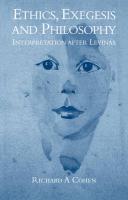
Book Summary
The reputation and influence of Emmanuel Levinas (1906-96) has grown powerfully. Well known in France in his lifetime, he has since his death become widely regarded as a major European moral philosopher profoundly shaped by his Jewish background. A pupil of Husserl and Heidegger, Levinas pioneered new forms of exegesis with his post-modern readings of the Talmud, and as an ethicist brought together religious and non-religious, Jewish and non-Jewish traditions of contemporary thought. Richard A. Cohen has written a book which uses Levinas' work as its base but goes on to explore broader questions of interpretation in the context of text-based ethical thinking. Levinas' reorientation of philosophy is considered in critical contrast to alternative contemporary approaches such as those found in modern science, psychology, Nietzsche, Freud, Husserl, Heidegger, Sartre, Merleau-Ponty, Derrida and Ricoeur. Cohen explores a manner of philosophizing which he terms 'ethical exegesis'.
Book Details
| Book Name | Ethics, Exegesis And Philosophy: Interpretation After Levinas |
| Author | Richard A. Cohen |
| Publisher | Cambridge University Press (Nov 2007) |
| ISBN | 9780521047166 |
| Pages | 372 |
| Language | English |
| Price | 3723 |